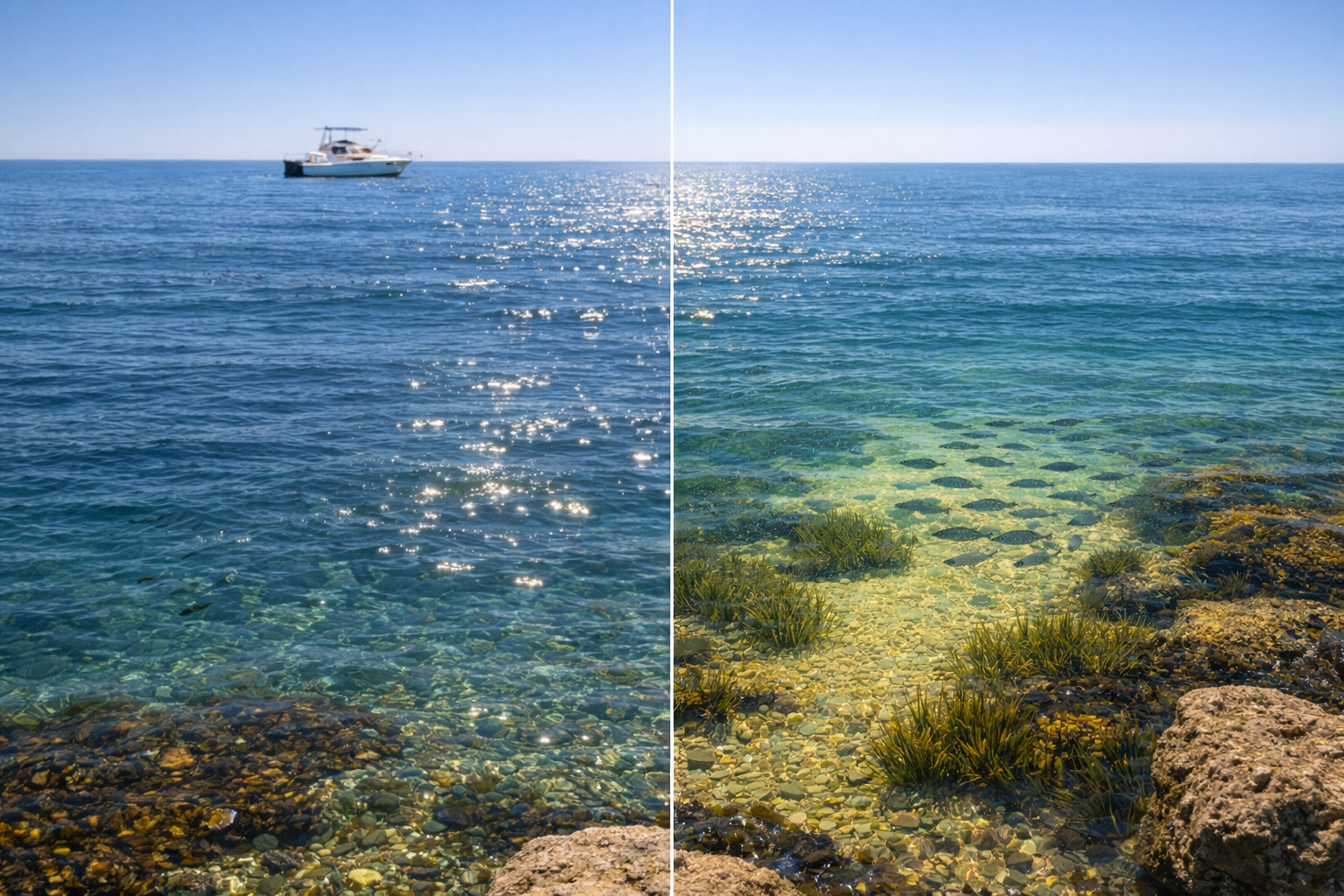
I still remember standing on a low rock ledge one calm morning, convinced the spot was empty. The sun was already high, the surface flat and blinding. Only after putting on polarized sunglasses did the bottom suddenly appear. Dark weed patches, a pale sand strip, and a single cruising fish that had been invisible seconds before.
That moment sums up why polarized sunglasses for fishing matter. They are not about style. They are about seeing more, fishing safer, and making better decisions in salt water.
This guide explains what polarized fishing sunglasses actually do, which types make sense for different situations, and which features matter in real use from shore and boat. It is not a brand comparison. The goal is to help you choose something that works reliably on your coast, in your light, and during long sessions.
Practical Overview: What Polarization Really Does
Polarization filters horizontal glare reflected off the water surface. In practice, that means less blinding shine and more usable contrast below the surface. Depth changes become clearer, structure stands out earlier, and subtle movements are easier to spot.
For shore anglers, this also improves safety. You see submerged rocks sooner, judge swell more accurately, and place your feet with more confidence on wet ground. In shallow sandy areas, better visibility can also help you avoid stepping near species like the greater weever, which often bury themselves just below the surface.
I underestimated this for a long time and treated sunglasses as a nice extra. Once I started paying attention to lens quality and fit, the difference was immediate. Fewer missed details, less eye strain, and a calmer overall feel during long tides. The benefit is not theoretical. In bright saltwater environments, it shows up every single session.
Best Fishing Sunglasses: Key Types and When to Use Them
When anglers search for the best fishing sunglasses, they usually want a simple answer. In reality, it depends on how and where you fish. Lens material, lens color, and frame design all play a role, and each comes with trade-offs.
Glass lenses offer excellent clarity and resist scratches well, which is valuable over time. The downside is weight. Polycarbonate lenses are much lighter and more impact resistant, which matters when fishing heavy lures, walking on rocks, or dealing with waves. For mobile shore fishing, lighter lenses are often more comfortable over several hours.
Lens color shapes how you read the water. Grey lenses reduce brightness evenly and work best in strong sun on open water.
Brown or copper lenses increase contrast and make bottom features stand out in shallow water. That extra contrast becomes especially useful when working lures slowly over mixed ground for seabass. I explain how reading subtle structure influences positioning in my guide on how to catch sea bass from shore.
Green lenses sit between the two and work well when light conditions change throughout the day. I noticed the biggest difference with contrast-boosting lenses when fishing mixed ground in one to three meters of water.
Important Features and Specs to Look At
When people talk about polarized sunglasses for fishing, they often reduce the decision to “dark or not.” In real use, the details matter much more. A good pair does several quiet jobs at once: it cuts glare, keeps your eyes relaxed, stays in place, and survives salt and abuse.
- Polarization quality is the foundation. True polarization removes flat surface glare without distorting the image underneath. Cheap lenses often look fine at first glance, but once you start moving your head or scanning the water, the picture becomes unstable. You may notice rainbow effects, shimmering edges, or a slightly oily look. Over a long session, that visual noise leads to faster eye fatigue and poorer depth perception. Good polarization feels calm. The image stays steady whether you look straight down into the water or scan along the surface.
- Lens color decides how you read the water. Grey lenses reduce brightness evenly and work best on open water under strong sun, where the main problem is intensity rather than contrast. Brown or copper lenses increase contrast, which makes a real difference in shallow water. Sand patches, rock edges, and weed lines stand out more clearly, especially in depths around one to three meters. Green lenses sit between the two and are a reliable all-round option when light changes throughout the day. I noticed this most when fishing mixed ground, where contrast mattered more than absolute brightness.
- Lens material affects both comfort and durability. Glass lenses deliver excellent clarity and resist scratches well, which pays off over time. The downside is weight. Polycarbonate lenses are much lighter and far more impact resistant. That matters when fishing heavy lures, walking on rocks, or dealing with sudden wave movement. For long shore sessions and mobile fishing, lighter lenses reduce pressure on the nose and ears and are simply easier to live with.
- Frame wrap and coverage are often overlooked. A frame that curves slightly around the face blocks stray light from the sides and reduces wind hitting the eyes. On exposed coasts, side glare can be just as distracting as glare from the water surface. Better coverage also helps keep the eyes from drying out in strong wind, which improves focus late in the session.
- Weight becomes noticeable faster than most people expect. The difference between roughly 25 and 40 grams does not sound dramatic, but after four or five hours it shows. Lighter sunglasses stay on your face instead of ending up on your hat. For long sessions, anything under about 30 to 35 grams feels noticeably more comfortable.
Best Polarized Sunglasses: Matching Lenses to Light and Water
The idea of the best polarized sunglasses only works if lenses match real light conditions. Bright midday sun, low winter angles, overcast skies, and harbor light all demand different behavior.
Very dark lenses can be perfect at noon in summer but become a problem early or late in the day. Medium-dark lenses handle changing light better and still provide enough glare reduction. I learned this on grey winter days when overly dark lenses made it harder to read the water than no sunglasses at all.
Understanding how light interacts with water is one of the small fundamentals that influences everything else you do on the coast, which is why I also explain it inside my broader guide to saltwater fishing basics.
Frame Design, Fit, and Comfort of Fishing Sunglasses
Good fishing sunglasses disappear once they are on your face. Bad ones constantly remind you they are there. Fit matters more than most people expect. Frames that slide when you sweat or look down quickly become irritating, and irritation leads to sunglasses being taken off.
For shore fishing, a secure fit helps when stepping down rocks or scanning the water near your feet. On boats, higher wrap and wind protection become more important. Venting can reduce fogging, but too much venting allows glare to creep in from the sides.
Comfort is not a luxury. If sunglasses are uncomfortable, they will not stay on when you actually need them.
Best Fishing Glasses for Different Situations
Talking about the best fishing glasses only makes sense when tied to real situations. A rocky shoreline, an open beach, and a boat deck all stress sunglasses in different ways.
On a rocky coast, stability and contrast matter most. Medium-wrap frames sit securely, and polycarbonate lenses make sense around hard ground and swinging lures. Brown or green lenses help reveal shallow structure and make wave patterns easier to read.
On open beaches under strong sun, glare dominates. Grey lenses reduce brightness evenly and keep the eyes relaxed during long, exposed walks. Low weight becomes important when covering distance with gear.
On boats, protection takes priority. Higher wrap blocks wind and spray, while impact-resistant lenses add a safety margin around heavy lures and sudden movements. Side glare is strong on open water, so coverage matters.
For travel, durability decides how long sunglasses last. Frequent packing, dashboards, and tight storage spaces punish fragile gear. Scratch-resistant lenses, solid hinges, and a hard case make a real difference on the road.
Common Mistakes That Lead to Disappointment
Many anglers buy the best polarized fishing sunglasses on paper and still end up disappointed. The problems are predictable. One common mistake is choosing lenses that are too dark for local conditions. What works in harsh summer sun can become a liability under clouds or in the early morning.
Fit is another issue that shows up quickly on the water. Sunglasses that slip or pinch become distracting and often end up pushed onto the head, where they stop doing anything useful. Trusting any generic “polarized” label is also risky. Not all polarization is equal, and poor quality only becomes obvious after hours of scanning water.
Impact protection is often ignored until something goes wrong, and side glare is frequently underestimated. Even good lenses lose much of their benefit if light constantly enters from the sides. I made all of these mistakes early on. Fixing them did not make me a better caster, but it made every session calmer, safer, and more controlled.
Polarized Fishing Sunglasses: Real-World Use, Care, and Safety
Polarized fishing sunglasses are also safety gear. They help you read waves, see submerged hazards, and track other anglers’ lines. On slippery rock or crowded spots, that matters.
Basic care keeps them working longer. Rinse lenses with fresh water after salt exposure, especially around hinges. Dry them before storage, and use a hard case in a backpack or van. I have scratched good lenses by tossing them loose next to pliers more than once.
Impact resistance is worth prioritizing around heavy lures. A 30–60 g lure swinging back in wind is not a rare event.
Best Polarized Sunglasses for Fishing: Final Thoughts
Polarized sunglasses for fishing are not an accessory. They are core gear that affects how long you can stay focused, how safely you move, and how well you read the water. Choosing lenses that match your light, frames that stay put, and materials that survive salt and impact removes a constant source of friction from your sessions.
Good sunglasses do not create success on their own. What they do is clear the noise. When glare stops fighting you, the water becomes easier to understand, footing becomes more confident, and fatigue sets in later. Get these basics right, and your sunglasses will quietly support every saltwater session instead of becoming another weak point.