The garfish is one of the most recognizable surface-dwelling fish along European coastlines. Long, slim, and often seen gliding just under the surface, it is a familiar sight for shore anglers from spring onward. Despite this visibility, garfish are frequently misunderstood, especially when it comes to their movements and seasonal presence.
This species profile looks at garfish through distribution, habitat, behavior, and environmental patterns across Europe. Some of my earliest saltwater memories involve watching garfish cut the surface like needles, completely ignoring everything below them.
Species Overview (Identification & Key Facts)
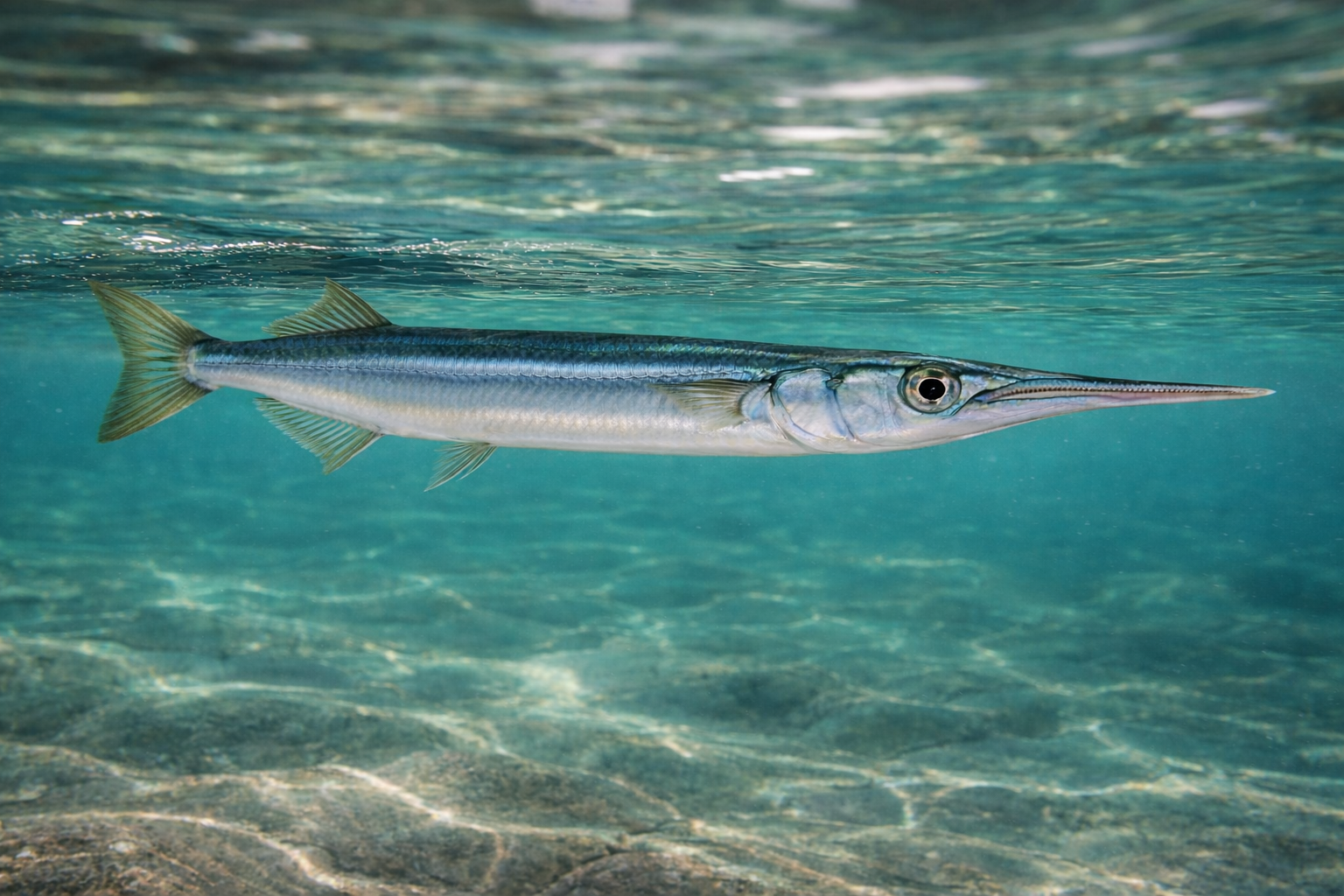
The European garfish (Belone belone) has a very distinctive shape. Its body is long, narrow, and cylindrical, ending in an extended beak-like jaw filled with sharp teeth. The back is blue-green, fading into silvery sides and a pale belly, which helps it blend into surface light.
Most garfish in European waters measure between 50 and 75 cm. Larger individuals can exceed 90 cm, though these are less common near shore. Garfish grow at a moderate pace and can live for up to 10 years. Juveniles resemble adults closely but are slimmer and more transparent. One unusual biological trait is their greenish bones, caused by the pigment biliverdin, which is harmless but often surprising.
European Distribution: Where You Encounter This Species the Most
Garfish are widely distributed across European waters. They are common along the Atlantic coasts of Portugal, Spain, France, the UK, and Ireland, and extend north into Norway and Denmark during warmer months. In the Mediterranean, they occur throughout Italy, Croatia, Greece, Turkey, and the western basin.
Atlantic garfish show strong seasonal migration. They move north and closer to shore as water temperatures rise in spring, then retreat southward or offshore in autumn. Mediterranean populations are more stable but still show seasonal inshore movement. Garfish are strongly surface-oriented and usually occupy the top 1 to 3 meters of the water column, rarely diving deep. Water temperature plays a major role, with inshore presence increasing once temperatures exceed roughly 10–12 °C.
Habitat & Behavior
Garfish are pelagic but closely tied to the coast. They favor open water near shore, often along beaches, headlands, harbor mouths, and areas with gentle current. They are rarely associated with bottom structure and instead patrol the surface layer.
Their diet consists mainly of small schooling fish such as sardines, anchovies, and juvenile mackerel. Garfish are visual hunters and rely heavily on light and clarity. Calm seas and clear water allow them to hunt efficiently near the surface. Activity is primarily diurnal, with reduced surface presence at night or during rough conditions.
Seasonally, behavior shifts with reproduction. During spawning periods, garfish move very close to land, often forming loose surface groups.
Angler Relevance & Shore Encounters
Shore anglers encounter garfish because the species regularly uses nearshore surface zones. Spring warming, stable weather, and baitfish movement bring them within sight of land. Their surface-oriented lifestyle makes them more visible than many other coastal species.
Human-made structures influence garfish distribution by altering current and concentrating bait near the surface. Harbors, piers, and breakwaters often create calm surface lanes. When garfish are not visible, anglers often assume they are absent, but the fish may simply be holding slightly farther offshore or deeper due to light or wave conditions.
Seasonal Presence & Environmental Patterns
Across Europe, garfish presence near shore peaks from spring through early summer. In Atlantic regions, this timing is closely linked to spawning migrations, which occur in shallow coastal water. In the Mediterranean, garfish can be present for longer periods, but inshore density still increases during spring.
Spawning typically takes place in late spring and early summer. Eggs are adhesive and attach to floating vegetation or debris. Light levels, calm seas, and warming surface temperatures act as biological triggers for coastal movement. Strong wind or swell quickly reduces surface activity.
Culinary & Cultural Importance
Garfish have modest culinary importance across Europe. They are eaten fresh in some regions, particularly in southern Europe, but are less valued elsewhere due to their slender shape and strong bones. In several coastal cultures, garfish runs are associated with seasonal change rather than cuisine.
Regulations, Size Limits & Sustainability
Regulations for garfish vary by country and are often limited. Some regions apply general size limits or seasonal rules, while others have few specific protections. Because garfish spawn close to shore, heavy pressure during spring can affect local presence. Checking local regulations and respecting spawning periods remains important.
Safety Considerations
Garfish are generally encountered in calm, shallow coastal water. However, their tendency to move fast at the surface can create hazards in crowded harbors or around swimmers. At night or in low light, surface activity can be harder to judge. Awareness of surroundings and other water users is more important than proximity to the fish.
Common Misconceptions About This Species
A common misconception is that garfish are present year-round, when in many regions they are strongly seasonal. Another is that they live only offshore, despite their frequent inshore spawning movement.
Many anglers assume garfish disappear during rough weather, when they often simply move deeper or farther out. Others mistake them for juvenile needlefish species, overlooking their true size and migration patterns. Finally, surface absence is often confused with population decline rather than behavioral change.
Garfish (Belone belone): Final Thoughts
Garfish are defined by surface-oriented behavior, seasonal migration, and strong dependence on light and temperature. They are most commonly encountered along European coastlines during spring and early summer, especially in calm conditions. Seasonal movement explains their sudden arrival and equally sudden disappearance. For me, garfish are a clear signal that the surface layer has come alive again.
Gear I Personally Use for Garfish From Shore
If you want to go a bit deeper into the tackle side, these guides explain how to choose the right gear for garfish from piers, harbor walls, calm beaches, and sheltered bays.
Garfish are not about power. They are surface-oriented, curious feeders with relatively soft mouths. Your setup should focus on light presentation, subtle control, and good visibility rather than brute strength:
- Best saltwater fishing rods for casting metals and controlling hard runs
- Best saltwater spinning reels for long casts and hard runs
- Best saltwater lures for bluefish (fast metals, topwater, and minnow plugs)
You don’t need heavy tackle for garfish. In fact, too much power often works against you. Balanced, light gear makes the whole experience more controlled and far more enjoyable.