The Painted Comber is a small coastal fish that many European shore anglers recognize instantly, even if they rarely think much about it. It is common, colorful, and often the first fish seen hovering over rocky ground in clear water. Because of its size and behavior, it is frequently misunderstood as insignificant or purely accidental.
This species profile looks at the Painted Comber through its distribution, habitat, behavior, and seasonal patterns across Europe. I’ve watched painted combers hold their ground in shallow water while everything else vanished with swell or light, which says a lot about how well adapted they are.
Species Overview (Identification & Key Facts)
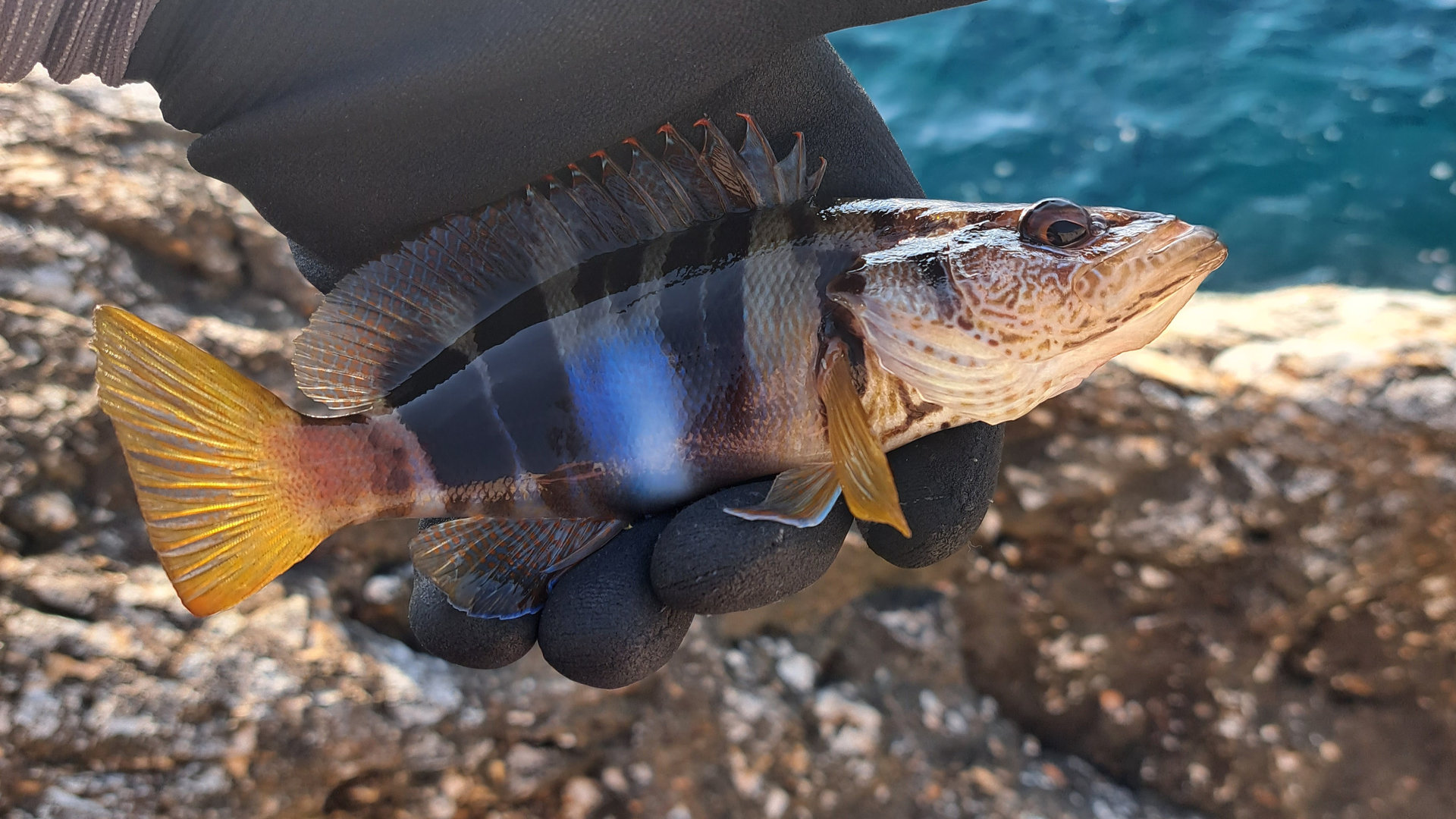
The Painted Comber (Serranus scriba) is a small member of the grouper family with a compact, laterally compressed body. Its coloring is striking, with a mix of reddish-brown, yellow, blue, and violet markings, including a distinctive dark blotch behind the pectoral fin. The eyes are relatively large, giving it a slightly alert, watchful appearance.
Most Painted Combers measure between 15 and 25 cm in length, with weights rarely exceeding a few hundred grams. The maximum recorded length is around 36 cm, though such individuals are uncommon. Growth is relatively slow, and the species can live for more than 10 years.
Juveniles show similar color patterns to adults but tend to be paler and more translucent. One notable biological trait is that Painted Combers are simultaneous hermaphrodites, possessing both male and female reproductive organs.
European Distribution: Where You Encounter This Species the Most
The Painted Comber is primarily a southern European species. It is widespread throughout the Mediterranean Sea, including the coasts of Spain, Italy, Croatia, Greece, and Turkey. It is also present in the eastern Atlantic, particularly along the coasts of Portugal, southern Spain, and Morocco.
Unlike many coastal fish, the Painted Comber does not extend far north. It is rare or absent in colder waters such as the UK, Ireland, Norway, and Denmark. The species prefers stable, warmer conditions and is most common where water temperatures regularly exceed 14–15 °C. Painted Combers are strongly inshore fish, typically found from the shoreline down to about 30 meters, with highest densities in the upper 5 to 20 meters.
Seasonal movement is limited compared to migratory species. Rather than large-scale migrations, Painted Combers show small depth shifts related to temperature and spawning.
Habitat & Behavior
Painted Combers are closely tied to rocky habitats. They favor reefs, boulder fields, breakwaters, and rocky patches interspersed with sand. Crevices, overhangs, and small holes provide shelter, and individuals often maintain a very small home range.
They are ambush-oriented feeders, relying on cover rather than speed. Their diet consists mainly of small fish, crustaceans, and benthic invertebrates. Painted Combers are highly visual and react strongly to movement but are less influenced by current than many pelagic species, which is why many shore anglers prefer light and sensitive saltwater fishing rods when exploring rocky structure.
Clear water suits them well, as it allows precise positioning close to structure, and on bright days polarized sunglasses for saltwater fishing make it much easier to spot fish hovering above rocks.
Activity is primarily diurnal. During daylight, Painted Combers often hover openly above rocks, retreating quickly if disturbed. At night, they tend to stay closer to shelter. Seasonal changes mainly influence depth preference, with slightly deeper holding during colder periods.
Angler Relevance & Shore Encounters
For many shore anglers learning the fundamentals of coastal fishing, Painted Combers are one of the first species they notice because the fish lives exactly where people access the coast.
Rocky shorelines, harbor walls, and breakwaters provide ideal structure and protection. Their territorial nature keeps them close to specific spots rather than roaming widely.
Painted Combers often remain present even when conditions feel quiet. Because they do not school or move visibly through water, anglers sometimes assume they appear only randomly. In reality, they are usually there already, simply holding close to cover and reacting cautiously to disturbance.
Seasonal Presence & Environmental Patterns
Painted Combers are present year-round in much of their range. In the Mediterranean, they remain active throughout the seasons, although colder winter temperatures reduce visible movement. In Atlantic waters, activity increases during warmer months when coastal temperatures stabilize.
Spawning generally occurs in late spring and summer, triggered by rising water temperature and longer daylight. During this period, individuals may be seen more frequently in slightly shallower water. Swell and turbidity tend to reduce visible activity, as Painted Combers rely heavily on sight and shelter.
Culinary & Cultural Importance
The Painted Comber has limited commercial importance due to its small size. In some Mediterranean regions, it appears occasionally in mixed local catches but is not a major market species. Culturally, it is better known as a familiar reef fish than as food, often appreciated more for its appearance than its table value.
Regulations, Size Limits & Sustainability
Regulations for Painted Comber vary by country and are often minimal due to its low commercial value. However, local size limits or general coastal fishing rules may still apply. Because the species is territorial and slow-growing, repeated pressure on small areas can have local effects. Respecting local regulations and avoiding unnecessary harvest supports long-term stability.
Safety Considerations
Painted Combers inhabit rocky environments that can be hazardous to access. Slippery stones, surge around breakwaters, and sudden swell changes are common risks. Clear water can give a false sense of calm, especially in shallow areas where footing matters most. Awareness of conditions is more important than proximity to fish.
Common Misconceptions About This Species
A common misconception is that Painted Combers are juvenile groupers, rather than a distinct species. Another is that they only appear in summer, even though they are present year-round in suitable habitats.
Many anglers assume Painted Combers indicate poor fishing conditions, when they simply reflect stable rocky habitat. Others believe they move widely along the coast, ignoring their strong site attachment. Finally, their small size often leads to underestimating their ecological role as resident reef predators.
Painted Comber (Serranus scriba): Final Thoughts
The Painted Comber is defined by color, site fidelity, and close association with rocky coastal habitats. It is most commonly encountered along warm European shorelines with stable structure and clear water. Seasonal shifts are subtle, driven more by temperature than migration. Seeing a Painted Comber hold its ground in shallow rock tells me the habitat itself is still doing something right.