I still remember one quiet evening on a Portuguese breakwater, the sea almost flat, the wind finally gone after a long day. I tied on a bright red minnow, 14 cm long and roughly 25 g, convinced that this was the “aggressive” color that would wake the fish up.
Two hours later my hands were cold, no bite at all, and a local guy a few meters down the rocks landed two seabass on a dull, almost grey soft plastic. Standing there in the dark, I caught myself wondering: can fish see color at all, or am I just fishing for my own confidence?
Living full time in the van and fishing new coasts all the time doesn’t allow many illusions. If something keeps failing across Portugal, Greece, Spain and Norway, it’s probably not bad luck. Color was one of those topics where I slowly realized I had been oversimplifying things for years.
Can fish see color? The short answer
Yes, fish can see color. Most saltwater fish do not see the world in black and white. Many species clearly see colors, but they don’t see all colors equally well, and they don’t see them the same way we do above water.
What really matters for shore fishing is not the abstract question “do fish see in color,” but what colors are still visible under the exact conditions you’re fishing. Light, depth, water clarity and time of day decide that, not the label on the lure box.
Over time, this also changed how I look at lure selection in general, and why I now focus more on a few proven profiles and weights rather than endless color variations, which I break down in my guide to the best saltwater lures for shore fishing. I didn’t suddenly catch twice as many fish, but I stopped wasting time and mental energy on constant lure changes.
What colors do fish see as depth increases
Water filters light very quickly. I first noticed this properly while snorkeling in Greece, watching my fins change color as I went deeper. The same thing happens to lures.
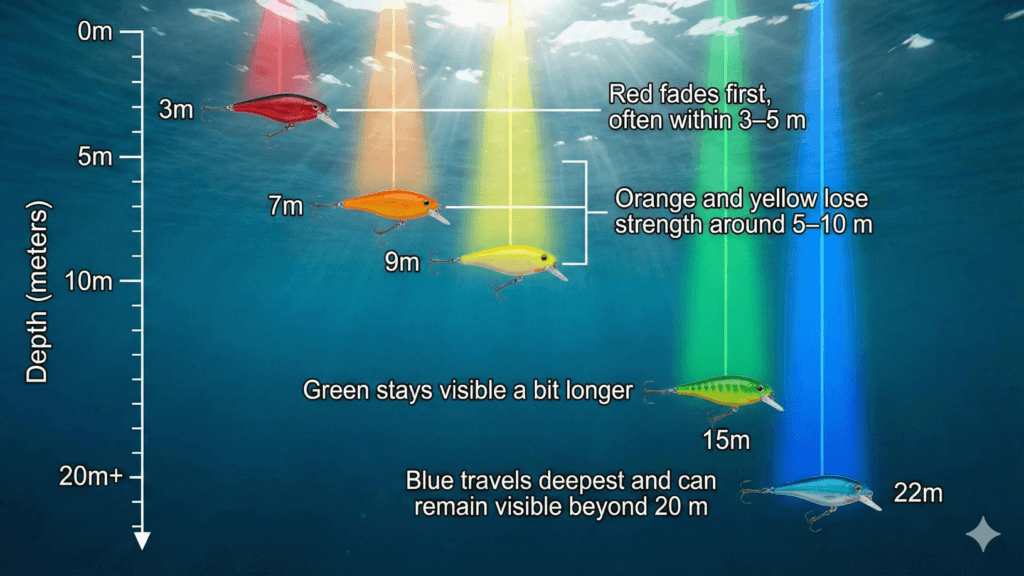
From both observation and results, this rough rule has proven reliable for me:
- Red fades first, often within 3–5 m
- Orange and yellow lose strength around 5–10 m
- Green stays visible a bit longer
- Blue travels deepest and can remain visible beyond 20 m
So when I’m fishing a rocky point in 6–8 m of water at dusk, that bright red lure isn’t really red anymore. To the fish, it’s mostly a dark shape. That doesn’t mean it never works, but it means the “red” part is no longer the reason.
Whenever someone asks me what colors can fish see, my honest answer is always: it depends on how much light is left at the depth you’re fishing.
Can fish see colors at night?
At night, color perception drops, but it doesn’t disappear completely. Around artificial light, fish react strongly to brightness and contrast. Under warm yellow harbor lights, pale lures can glow softly and look alive. Under cold LED lights, darker lures often stand out better against the background.
I keep it simple: I carry one light-colored and one dark-colored lure ready. If neither gets interest after 30–40 casts, I move. Endless color changes at night usually mean I’m fishing the wrong spot, not the wrong lure.
Night fishing also demands respect. Slippery concrete, algae-covered rocks and limited visibility are real hazards. Good footwear and a headlamp are not optional.
Do fish see in color the same way we do?
No. Fish eyes are built differently from ours. Many saltwater species have cone cells that allow color vision, but their sensitivity is often shifted toward blues and greens. For predators like seabass, mackerel, pollack or bluefish, detecting movement and contrast is often more important than identifying a precise shade.
From the rocks, I simplify it like this: When visibility is good, fish can afford to be picky. When visibility drops, contrast beats color.
That explains why a plain white 20 g jig can outfish a beautifully painted lure in stirred-up water, and why a black or dark purple lure can work surprisingly well at night.
How I actually choose lure colors now
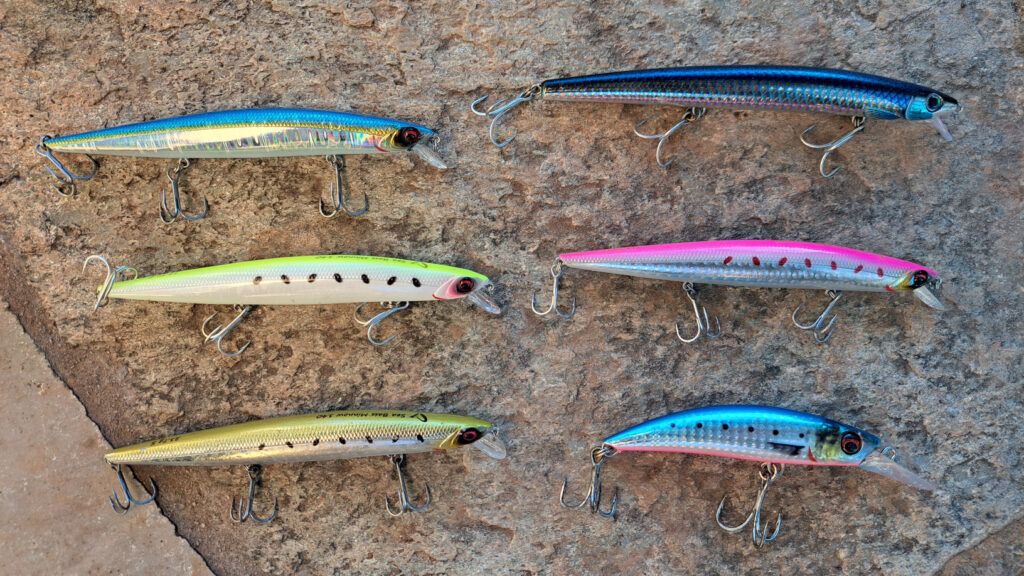
I fish mostly spinning gear from shore, so this is how I break it down in real sessions, not theory. I usually fish a 2.4–3 m rod, paired with a 3500–4000 size reel, braid and a leader long enough to survive rocks and concrete.
On the reel side, I care less about brand names and more about a smooth drag and a reliable build that won’t fall apart around salt and spray. Because I’m on foot and often in unfamiliar places, I need a system that works for many conditions.
Clear water, daylight or bright overcast
When the water is clear and the light is strong, fish can inspect everything. In these conditions I trust natural baitfish colors. Sardine, anchovy, translucent patterns with a subtle back work best for me. I usually fish 10–14 cm lures, weighing 12–35 g, and keep my retrieve controlled and clean.
Slightly stained water or low light
At dawn, dusk, or when there’s some swell, visibility drops. This is where I move toward white, pearl or light chartreuse. These colors don’t try to look real, they try to be visible. I often step up to 20–40 g lures to maintain control and feel.
Murky water, foam, or night fishing
In dirty water or under harbor lights, I care less about color realism and more about silhouette. Black, dark blue or purple create a strong outline that fish can track. At night, especially between 21:00 and 01:00, I often fish slower and closer, focusing on shadow lines and edges.
Why color matters differently from shore
From shore, I can’t change depth freely. My effective range is often 40–70 m, depending on wind and lure weight. I’m fishing specific layers whether I like it or not.
Boat anglers can follow fish and adjust depth instantly. From shore, lure visibility becomes one of the few variables I can control easily. Choosing a color that stays visible in my depth window gives me a small but important edge.
Can fish see colors? My honest takeaways
If I had to sum this up for a friend standing next to me on a windy jetty, it would sound like this: Fish do see color, but it’s never the whole story. Red works shallow, blue works deep, and everything in between depends on light and water clarity. When conditions are tough, contrast matters more than fancy paint jobs.
Fewer, well-chosen colors outperform a tackle box full of options. And most importantly, color never fixes bad timing, bad positioning or unsafe footing. Understanding how fish see color didn’t make my fishing spectacular. It made it simpler, calmer and more consistent. And from the rocks, that’s usually the difference between fishing with confidence and just guessing.