The Atlantic Bonito is one of the fastest, most misunderstood pelagic fish regularly encountered along European coasts. It looks like a small tuna, behaves like a hunter built for chaos, and often appears close to land when conditions line up.
Many shore anglers see it only in brief windows and assume it is rare, when in reality it is highly mobile and tightly linked to temperature and bait movement. This profile explains what the Atlantic Bonito actually is, where it occurs in Europe, how it behaves, and why it shows up when it does.
Species Overview (Identification & Key Facts)
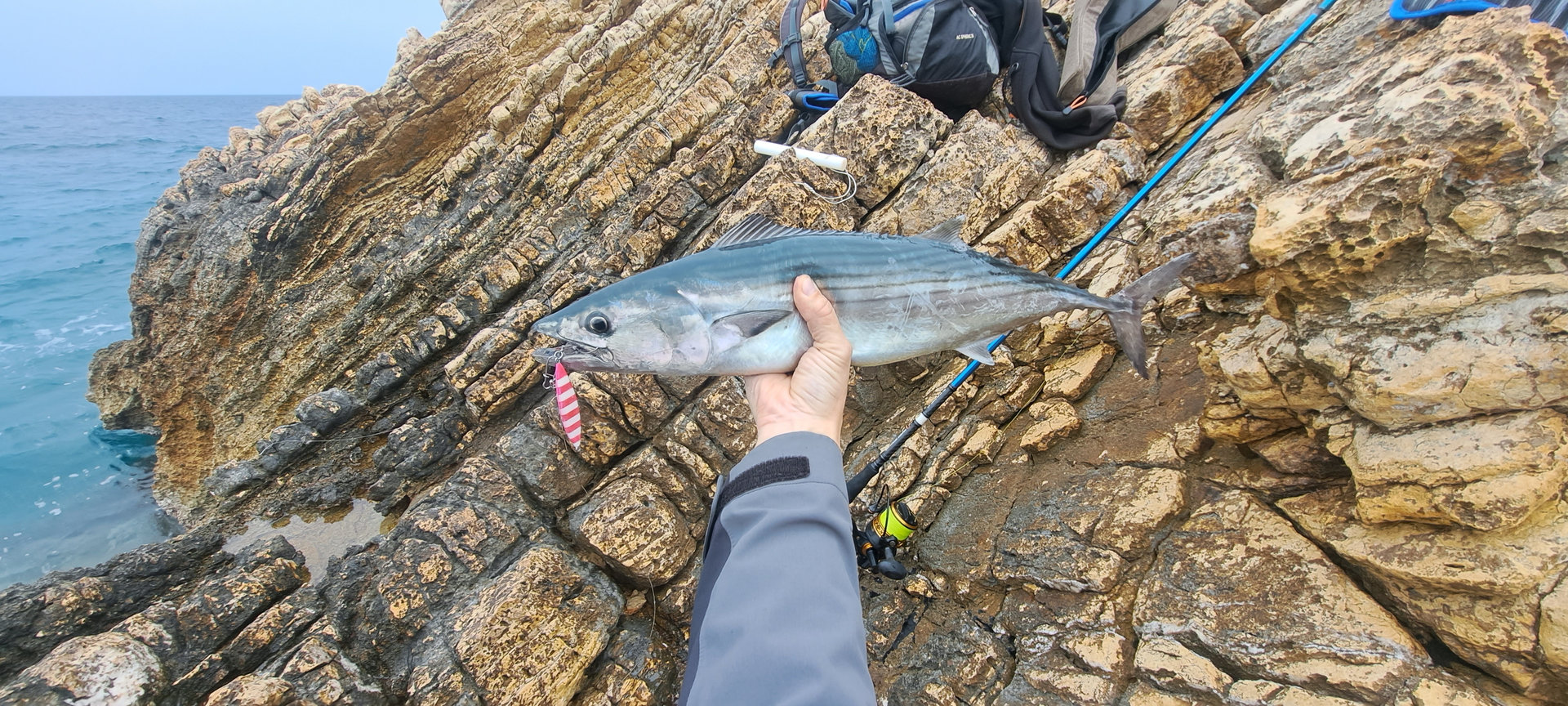
The Atlantic Bonito (Sarda sarda) is a streamlined, muscular fish with a torpedo-shaped body built for speed. Its back is deep blue to steel-grey, marked by 5–11 dark, oblique stripes that run from the head toward the tail, a key feature that separates it from similar-looking species. The belly is silver-white, clean and unmarked.
In European waters, most individuals range between 40 and 70 cm in length, with weights commonly between 1.5 and 4 kg. Larger specimens occur, and globally the species can exceed 90 cm and 10 kg, though these sizes are uncommon close to shore. Atlantic Bonito grow fast, often reaching sexual maturity within two to three years, and rarely live beyond 10 years.
Juveniles tend to form dense schools and stay closer to warmer surface layers, while adults are more dispersed and capable of deeper, faster movements. The stiff, deeply forked tail and narrow caudal peduncle reflect its role as a constant swimmer rather than an ambush predator.
European Distribution: Where You Encounter This Species the Most
The Atlantic Bonito is widely distributed across European waters but shows strong regional patterns. It is common along the Atlantic coasts of Portugal and Spain, frequent around western France, and regularly present in the Bay of Biscay. It reaches the British Isles during warmer periods and has been recorded as far north as southern Norway during exceptional warm years.
In the Mediterranean, it is well established from Spain and France through Italy, Croatia, Greece, and Turkey. Presence is generally more stable in the eastern Mediterranean, where summer surface temperatures remain high for longer. The species is largely absent from cold, low-salinity zones and avoids enclosed brackish systems.
Atlantic Bonito are primarily surface-oriented but are comfortable from near-surface layers down to roughly 200 meters, depending on temperature and prey. Their movements are closely tied to water temperature, typically favoring ranges above 18 °C, and to salinity levels consistent with open marine conditions. Seasonal migrations often follow spawning and baitfish concentrations rather than fixed coastlines.
Habitat & Behavior
This species prefers open water but regularly approaches coastal zones when prey is compressed against land or structure. Rocky headlands, island chains, current lines, and steep drop-offs all act as natural funnels for its feeding behavior. It is less associated with seagrass or soft bottom habitats and more with moving water and clean depth transitions.
Atlantic Bonito feed mainly on small schooling fish such as sardines, anchovies, and mackerel, as well as squid when available. Feeding is aggressive and often involves high-speed chases near the surface. They respond strongly to current, swell, and water clarity, with clear water and defined current edges favoring surface activity.
They are predominantly daytime hunters, relying heavily on vision. At night, activity drops sharply, and they tend to move deeper or disperse. Seasonal shifts are pronounced, with warmer months bringing tighter schools and more surface-oriented behavior.
Angler Relevance & Shore Encounters
Shore anglers encounter Atlantic Bonito not because it is coastal by nature, but because coastlines sometimes intersect its feeding routes. When baitfish are driven toward land by current, wind, or predators, bonito follow. Human-made structures such as breakwaters and harbor entrances can intensify this effect by altering water flow and concentrating prey.
The species is often present but unseen. Its speed, mobility, and short feeding windows mean it can pass through an area quickly, creating the impression of randomness. Calm water does not mean absence, and rough water does not guarantee presence; the deciding factor is usually prey position rather than surface conditions alone.
Seasonal Presence & Environmental Patterns
Across most of Europe, Atlantic Bonito appear from late spring through autumn. In Atlantic waters, peak presence typically aligns with late summer, when surface temperatures stabilize and baitfish biomass is high. In the Mediterranean, the season often starts earlier and lasts longer, sometimes extending into early winter.
Spawning usually occurs in warm offshore waters, and post-spawning movements often bring fish closer to land as they resume intensive feeding. Light levels influence daily activity, while swell and current act as triggers by shaping bait distribution rather than directly affecting the fish.
Culinary & Cultural Importance
Atlantic Bonito holds modest but meaningful culinary value in southern Europe. It is commonly sold fresh in Mediterranean markets during peak season and is also used for preserved products in some regions. The flesh is dark, firm, and strongly flavored, becoming more pronounced in larger individuals. Historically, it has been an accessible, working-class fish rather than a luxury species.
Regulations, Size Limits & Sustainability
Regulations for Atlantic Bonito vary widely across Europe. Some countries apply size limits or seasonal restrictions, while others manage it under broader pelagic species rules. Because the species forms spawning aggregations, ethical considerations are especially relevant during reproductive periods. Local regulations should always be checked before any harvest decisions are made.
Common Mistakes & How to Avoid Them
- Fishing Too Slow: The most common error is reeling at a “pike” or “seabass” pace. Bonito are built for speed. If you think you are reeling fast, reel faster. They can swim at speeds of over 60 km/h; you cannot outrun them with a fishing reel.
- Using Wire Leaders: Despite their teeth, bonito have excellent eyesight. Using a wire trace will drastically reduce your number of bites. Instead, use a high-quality fluorocarbon leader in the 0.30 mm to 0.40 mm range. It is usually abrasion-resistant enough to survive a fight, provided you check it for nicks afterwards.
- Ignoring the Birds: Bonito push bait to the surface, which attracts seagulls and terns. If you see birds diving 500 meters down the coast, that is where the fish are. Mobile anglers who chase the birds catch more fish than those who wait for the fish to come to them.
- Over-Gunned Gear: While they fight hard, you don’t need heavy boat gear. A standard spinning rod rated for 20–60 g is perfect. Using gear that is too heavy makes casting small metal jigs difficult and takes the fun out of the fight.
Safety Considerations
Encounters often occur around exposed headlands, harbor mouths, or offshore-facing structures where current and swell interact. These locations can change quickly with wind shifts and boat traffic. Fast-moving surface activity can draw attention away from footing, so awareness of surroundings is essential, especially in low light or rough conditions.
Common Misconceptions About This Species
One common assumption is that Atlantic Bonito are simply small tuna. While related, their behavior is more erratic and coastal interactions are more frequent. Another misconception is that they are rare from shore; in reality, they are transient rather than scarce.
Some anglers believe they require warm, flat water, yet many encounters happen during dynamic conditions driven by current. They are also often assumed to be strictly offshore, ignoring how often prey dynamics pull them tight to land. Finally, inconsistent sightings lead to the false idea of population swings, when short residence time is usually the explanation.
The Atlantic Bonito (Sarda sarda): Final Thoughts
The Atlantic Bonito is a fast-growing, highly mobile pelagic predator that bridges offshore and coastal worlds. It is most commonly encountered in warm months, near current-driven structure, and wherever baitfish are compressed. Understanding its biology and movement patterns explains why it appears suddenly and disappears just as fast. For me, it remains a reminder that presence in the sea is often about timing and conditions, not permanence.
Gear I Personally Use for Atlantic Bonito From Shore
If you want to go a bit deeper into the tackle side, these guides help you choose gear that actually fits bonito fishing from open beaches, headlands, and exposed breakwaters.
Atlantic bonito are pure speed. They move fast, feed aggressively on bait balls, and rarely give you a second chance. Long casting distance, high retrieve speed, and a smooth but reliable drag system matter more than finesse:
- Best saltwater fishing rods for casting metals and controlling hard runs
- Best saltwater spinning reels for long casts and hard runs
- Best saltwater lures for bluefish (fast metals, topwater, and minnow plugs)
You don’t necessarily need extremely heavy gear for bonito, but you do need tackle that can handle speed without feeling unstable. When a bonito hits at full pace, weak setups show their limits immediately.